
Leadership and the Importance of Self-Awareness in Disaster Relief Incident Management
Exploring Constructive Leadership in a Crisis
Leadership is often associated with vision, strategy, and the ability to inspire others. Incident management demands a unique blend of leadership skills, adaptability, and interpersonal effectiveness. Leaders must guide teams under pressure, make decisions amid uncertainty, and maintain morale in extreme and often chaotic circumstances. However, beneath the surface of these visible attributes lies a critical and sometimes overlooked element: self-awareness. True leadership development begins with deep understanding of oneself—strengths, weaknesses, values, motivations, and impact on others. Self-awareness is the cornerstone on which authentic, adaptive, and effective leadership is built and can be cultivated using a purpose designed diagnostic tool. This article explores the relevance of one leadership tool within disaster relief incident management, illustrating how self-awareness optimises team performance and outcomes.
The Concept of Self-Awareness
Self-awareness can be defined as conscious knowledge of one’s character, feelings, motives, and desires. It involves a continuous process of reflection, introspection, and honest assessment. Leaders who are self-aware recognise their emotional states, understand how their behaviour affects others, and align their actions with their core values. This internal clarity differentiates competent managers from transformative leaders.
Components of Self-Awareness
- Emotional awareness: Understanding emotions and how they influence thoughts and actions.
- Accurate self-assessment: Recognising strengths, limitations, and areas for development.
- Self-confidence: Possessing a strong sense of self-worth and capability rooted in realism and humility.
Why Self-Awareness Matters in Leadership
Self-awareness forms the foundation for many of the competencies leaders need to succeed. Here’s why it is indispensable:
- Improved decision making: Leaders who are aware of their biases and habitual responses are better able to make objective, rational choices.
- Enhanced emotional intelligence: Self-awareness is the first step in developing emotional intelligence, which is crucial for building relationships and managing teams effectively.
- Authenticity and trust: Leaders who know themselves and act consistently with their values inspire trust and commitment among their followers.
- Resilience and adaptability: A self-aware leader is more resilient in the face of setbacks and more willing to adapt and learn from mistakes.
- Empowerment of others: By understanding their strengths and limitations, leaders can more effectively empower and develop those around them.
Developing Self-Awareness
Though some may believe self-awareness is an innate trait, it can be cultivated through intention and practice.
Seeking feedback from colleagues, mentors, and team members provides valuable perspectives that may be blind spots to oneself. Regular, structured feedback—such as 360-degree diagnostic assessments—can illuminate patterns in behaviour, areas for growth, and strengths to be leveraged. One such diagnostic assessment instrument is the Human Synergistics® Life Styles Inventory™ (LSI).
Understanding the Human Synergistics® Life Styles Inventory™
The LSI is a self-assessment tool developed by Human Synergistics International®. It offers a powerful framework for understanding personal thinking and behaviour patterns, which can profoundly influence leadership effectiveness in such high-stakes environments. The LSI is grounded in decades of research on organisational culture and human effectiveness.
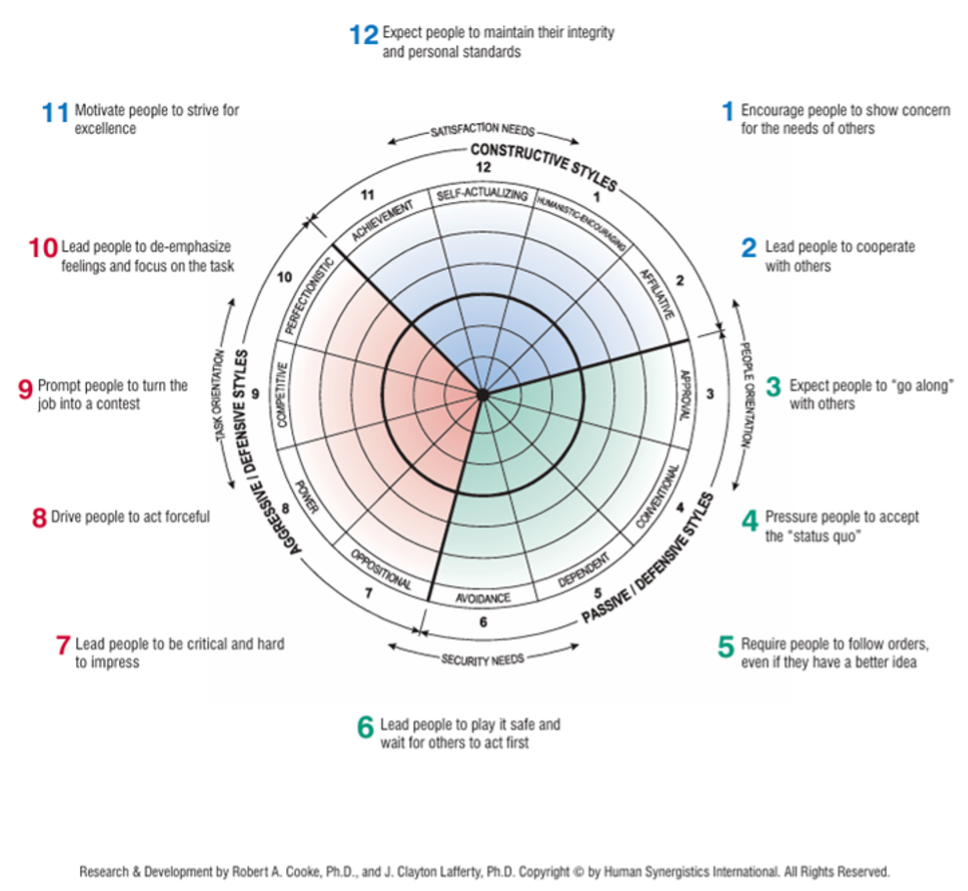
The inventory evaluates 12 distinct styles of thinking and behaviour, which are grouped into three clusters: Constructive, Passive/Defensive, and Aggressive/Defensive. Each style reflects underlying motivations, attitudes, and interaction patterns:
- Constructive styles: achievement, self-actualising, humanistic-encouraging, affiliative.
- Passive/Defensive styles: approval, conventional, dependent, avoidance.
- Aggressive/Defensive styles: perfectionistic, competitive, power, oppositional.
The LSI provides a self-report (LSI 1) and 360-degree feedback (LSI 2), allowing for robust insights into how individuals perceive themselves (i.e. their thinking patterns) and how they are perceived by others through their observed behaviours.
Leadership in Disaster Relief Incident Management
Disaster relief operations are characterised by urgency, complexity, and unpredictability. Leaders must quickly mobilise resources, coordinate diverse teams, and communicate clearly, all while managing stress and emotional strain. Successful disaster relief leadership hinges on qualities such as decisiveness, resilience, empathy, and the ability to foster collaboration amid pressure. In these contexts, understanding and adapting one’s personal style can make the difference between chaos and coordinated action.
The Unique Demands of Disaster Relief Leadership
- Time sensitivity: Decisions must be made rapidly, often with incomplete information.
- Team diversity: Relief teams consist of varied individuals—professionals, volunteers, and community members—each with different backgrounds and expectations.
- High stress: The emotional toll of disaster—loss, fear, uncertainty—can impact judgement, morale, and cooperation.
- Ambiguity and change: Plans and priorities may shift as new information emerges.
These conditions require leaders who are not only technically competent but also self-aware, emotionally intelligent, capable of engaging others productively, and adaptable to rapidly changing scenarios.
Connecting the LSI to Disaster Relief Leadership
The LSI’s value in incident management lies in its ability to help leaders identify and cultivate Constructive styles while mitigating Defensive tendencies. These styles directly influence how leaders handle stress, interact with their teams, and respond to the evolving demands of disaster relief.
Constructive Styles: The Cornerstone of Effective Disaster Relief Leadership
Constructive styles emphasise growth, achievement, encouragement, and affiliation—qualities that are particularly vital in crisis scenarios. Leaders who score highly in these areas tend to:
- Foster collaboration: Humanistic-encouraging and affiliative leaders create an atmosphere of mutual respect and open communication, essential for rapid coordination and morale.
- Drive results: Achievement-oriented leaders set clear goals, motivate teams, and maintain focus on outcomes despite obstacles.
- Promote resilience: Self-actualising leaders model adaptability, creativity, and optimism, helping teams persevere under stress.
For example, an Incident Controller who exhibits a humanistic-encouraging style is likely to empower volunteers, validate their contributions, and maintain morale, while an achievement-oriented leader ensures that operational objectives are met efficiently.
Mitigating Defensive Styles in High-Pressure Environments
The Passive/Defensive and Aggressive/Defensive styles—while sometimes adaptive—can undermine incident management if they dominate leadership behaviour:
- Passive/Defensive: Leaders who seek excessive approval, avoid conflict, or rely blindly on convention may struggle to make tough decisions or innovate in the face of new challenges. In incident management, such tendencies can slow response times and dampen initiative.
- Aggressive/Defensive: Overly perfectionistic, competitive, or oppositional leaders may alienate team members and create friction, undermining collaboration and trust when unity is most needed.
By illuminating these tendencies through the LSI, leaders can recognise when Defensive patterns emerge and intentionally shift towards more Constructive approaches.
Self-Awareness and Leadership Development
One of the central benefits of the LSI is the cultivation of self-awareness—a critical asset in disaster relief leadership. When leaders understand their habitual styles, they can:
- Adapt their approach to meet the needs of diverse teams and dynamic situations.
- Manage personal stress and regulate emotional responses.
- Build authentic relationships grounded in trust and encouragement.
- Seek and integrate feedback for continuous improvement.
The LSI empowers leaders to transform insight into action. By tracking development over time, leaders can assess progress, set goals, and sustain Constructive behaviours even in the most challenging conditions.
Constructive Leadership in Action
Consider a scenario in which an incident management team faces conflicting priorities: restoring critical infrastructure versus attending to immediate medical needs. A leader with high achievement and affiliative styles might facilitate a collaborative decision-making process, ensuring both tasks are addressed and that team members feel heard and valued, notwithstanding critical timeframes for actions to take place. Meanwhile, a leader with strong Defensive styles may become rigid, dismiss alternative viewpoints, or avoid necessary confrontation—potentially leading to suboptimal outcomes.
Similarly, in the aftermath of a natural disaster, leaders who embrace humanistic-encouraging behaviours can provide emotional support, acknowledge trauma, and help teams process loss, thereby sustaining engagement and effectiveness under strain.
Organisational Culture and Incident Management
Incident management does not occur in isolation; it is shaped by the broader organisational culture. Similar diagnostics can also be used to assess and develop team and organisational styles, fostering cultures that support constructive leadership at all levels. Organisations that prioritise constructive norms—such as open dialogue, encouragement, and continuous learning—are better equipped to respond to crises with agility and unity.
Leaders set the tone for the organisational culture. Self-aware leaders cultivate environments of trust, transparency, and psychological safety. These cultures are more innovative, resilient, and adaptive to change. When leaders model self-awareness, they encourage team members to do the same, creating a ripple effect of authenticity and continuous improvement.
Integrating the LSI into Training and Practice
By embedding the LSI into disaster relief leadership development programs, organisations can:
- Assist leadership candidates to develop strong constructive profiles through enhanced self-awareness.
- Customise training to address specific strengths and development needs.
- Facilitate 360-degree feedback to support team cohesion and alignment.
- Monitor cultural change over time, reinforcing constructive norms and practices.
Such integration helps ensure that leaders—and their teams—are prepared not only for the technical demands of disaster response but also for the interpersonal and emotional challenges inherent in crisis management.
Challenges and Considerations
While the LSI offers valuable insights, it is not a panacea. Its effectiveness depends on honest self-reflection, commitment to personal growth, and organisational support. Leaders must be willing to confront uncomfortable truths and persist in the face of setbacks. Additionally, cultural differences, personal backgrounds, and the unique pressures of disaster environments can influence how styles manifest and are perceived.
Conclusion
The Human Synergistics® LSI is highly relevant to developing self-aware leaders in disaster relief incident management. By illuminating the thinking and behaviour patterns that shape leadership effectiveness, the LSI empowers leaders to adopt constructive styles, foster collaboration, and sustain performance in demanding, high-pressure environments. Organisations that embrace the LSI as part of their leadership development toolbox are better equipped to cultivate resilient, adaptive, and empathetic leaders—those best positioned to make a meaningful difference when disaster strikes.
References
- Goleman, D. (2000). Leadership That Gets Results. Harvard Business Review.
- Human Synergistics International. (2024). Life Styles Inventory (LSI) Overview.
- Kapucu, N., & Van Wart, M. (2008). Leadership and Decision Making in Disaster Management. Public Administration Review.
- Northouse, P. G. (2021). Leadership: Theory and Practice. Sage Publications.