
The Role of Organisational Culture in Incident Management during Disaster Relief Operations
How Values, Norms, and Behaviours Shape Crisis Response
Disaster response operations are inherently complex, demanding rapid coordination, decisive leadership, and unwavering commitment in the face of chaos. At the heart of successful incident management lies an under-appreciated force: organisational culture. It is the invisible hand shaping behaviours, fostering resilience, and guiding decision-making in the most stressful of circumstances. This article explores the multifaceted role of organisational culture in incident management during disaster relief operations, dissecting how deeply rooted values and shared norms can mean the difference between coordinated response and disarray. It demonstrates that cultural awareness and alignment are not peripheral concerns but central to organisational performance in high-stakes, rapidly evolving environments, and provides strategies to achieve these outcomes.

Understanding Organisational Culture
Organisational culture is the amalgamation of shared beliefs, values, norms, and expectations that characterise an organisation. It influences how members interact, process information, and tackle challenges—especially when under the extreme pressures of disaster relief environments, often characterised by volatility, urgency, and uncertainty. In such conditions, the shared values and norms within organisations can accelerate or obstruct effective action. Under these conditions, organisational culture is not just a background consideration but a central pillar of effectiveness—it shapes communication channels, influences risk tolerance, and governs cross-agency collaboration. Diagnosing, understanding, and shaping these cultural attributes is therefore key to success. The Human Synergistics® Organisational Culture Inventory® (OCI) offers an opportunity for organisations to do just that.
Overview of the Human Synergistics® Organisational Culture Inventory® (OCI)
The Human Synergistics® OCI is a scientifically validated survey instrument used globally to assess the shared norms, values, beliefs, and behavioural expectations within an organisation. It evaluates culture across 12 distinct behavioural norms across three overarching styles: Constructive, Passive/Defensive, and Aggressive/Defensive. Constructive norms promote collaboration, innovation, and adaptability. Passive/Defensive norms can lead to excessive caution and delayed decisions. Aggressive/Defensive norms can drive competition and conflict, undermining coordination.
Through detailed reporting and analysis, the OCI enables leaders to understand the prevailing cultural styles and how these impact performance, collaboration, satisfaction, adaptability, and innovation. In disaster contexts, these norms directly influence the speed, quality, and coordination of the response. A Constructive, resilient organisational culture can foster adaptability, trust, and creativity, while a Defensive (Passive and/or Aggressive) fragmented or toxic culture can breed confusion, mistrust, and inertia.
The Unique Challenges of Disaster Management
Agencies involved in disaster response and recovery operate under extraordinary pressure. Their mission revolves around saving lives, protecting communities, and restoring functionality after catastrophic events. Key challenges include:
- High levels of uncertainty and volatility
- Time-critical decision-making
- Inter-agency collaboration
- Resource constraints and logistic complexity
- Emotional and psychological stress for staff and affected populations.
These environments demand not only technical competence but also resilient, adaptive, and cooperative cultures—qualities that can be measured, understood, and shaped using the OCI.
The Critical Importance of Culture in Disaster Management
Effective disaster management relies on timely communication, coordinated actions, and clear leadership—each of which is profoundly shaped by organisational culture.
- Decision-making under pressure: Organisational culture determines how decisions are made during a crisis. In a culture that values decentralised authority and trust, frontline responders are empowered to act swiftly. Conversely, a rigidly hierarchical culture may delay action as approvals are sought from higher management.
- Communication and information sharing: Open cultures promote information flow, encouraging staff to share updates, concerns, and insights without fear of reprisal. Conversely, cultures where information is hoarded or communication is siloed will struggle with situational awareness, which is critical for effective response.
- Learning orientation: Cultures that embrace reflection and learning foster debriefings, after-action reviews, and the institutionalising of lessons learned. This creates a feedback loop that continually strengthens incident management capacity.
- Collaboration and teamwork: Crisis response demands cooperation across multiple teams and agencies. Cultures that prioritise collaboration, mutual respect, and shared goals are more likely to overcome interdepartmental rivalries that can cripple relief efforts.
Organisational Culture in Disaster Relief: A Closer Look
Disaster response and relief operations often require integration of governmental agencies, non-governmental organisations (NGOs), military units, and community groups. Each brings an organisational culture, values, and practices. The interplay of these cultures can enhance synergy or foster friction.
Constructive Cultures as a Force Multiplier
Constructive cultures promote initiative, shared problem-solving, and psychological safety—all critical in crises.
Example – Christchurch Earthquake (2011):
Urban Search and Rescue teams demonstrated high affiliative and achievement-oriented behaviours, enabling seamless integration of Australian, New Zealand, and international responders. This reduced duplication of effort and improved rescue rates in the critical early hours.
Risks of Passive/Defensive Cultures
While compliance has its place in regulated emergency environments, excessive passive/defensive tendencies can be detrimental.
Example – Cyclone Nargis (2008):
In Myanmar, international aid was delayed due to bureaucratic insistence on formal approvals, despite urgent needs on the ground. The delay cost critical lives during the acute phase of the disaster.
Risks of Aggressive/Defensive Cultures
Aggressive/defensive norms may lead to rivalry, mistrust, and poor inter-agency coordination.
Example – Haiti Earthquake (2010):
Competition between NGOs and UN logistics teams slowed aid distribution, with multiple agencies setting up separate supply chains rather than pooling resources.
Mapping the Relevance of the OCI to Disaster Relief and Incident Management
Enhancing Team Performance and Cohesion
Effective disaster relief hinges on teams that can trust, communicate, and work together seamlessly. The OCI’s constructive cultural styles are strongly correlated with improved teamwork and morale. Organisations with these styles are more likely to:
In disaster scenarios, where rapid coordination is essential, constructive cultures can minimise friction, misunderstandings, and conflict, allowing responders to focus on their mission.
Promoting Adaptability and Innovation
- Proactive learning and continuous improvement
- Encouragement of individual initiative and innovation
- Constructive risk-taking and resilience in the face of setbacks.
Organisations with strong constructive cultures are better equipped to improvise solutions, adapt protocols, and reinvent processes in real time—critical competencies when stakes are high and conditions unpredictable.
Facilitating Inter-Organisational Collaboration
Disaster response and relief are rarely the responsibility of a single organisation; it involves coordination among government agencies, NGOs, private sector partners, and volunteers. The OCI can reveal cultural gaps or misalignments between collaborating entities. By understanding each organisation’s cultural profile, leaders can:
- Anticipate potential areas of misunderstanding or friction
- Design joint training, communication protocols, and leadership approaches that bridge divides
- Establish shared norms and values that support unified action.
This cultural intelligence enhances inter-agency effectiveness, breaking down barriers and building trust where it is most needed.
Supporting Leadership Development and Decision-Making
In disaster response and relief, leaders must provide direction under extreme pressure and uncertainty. The OCI highlights the impact of leadership styles on organisational culture. Leaders who model Constructive behaviours—such as empowering others, seeking input, and encouraging development—can shape cultures that are resilient, adaptive, and ethical.
Conversely, cultures dominated by Defensive styles may undermine decision-making, breed fear, and stifle initiative. The OCI allows leaders to identify and address these cultural barriers, ensuring their organisations can rely on confident, informed, and rapid decision-making when it matters most.
Developing a culture that supports optimal decision-making under pressure needs to be done intentionally and well in advance of the crisis occurring.
Reducing Burnout and Enhancing Wellbeing
Disaster relief workers face intense emotional and physical demands. OCI data helps organisations understand how their culture protects or jeopardises staff wellbeing. Research shows that Constructive cultures, where individuals feel valued and supported, are associated with lower burnout rates, higher job satisfaction, and greater retention—critical metrics for organisations that depend on committed, experienced personnel.
Applying the OCI Across the Disaster Management Cycle
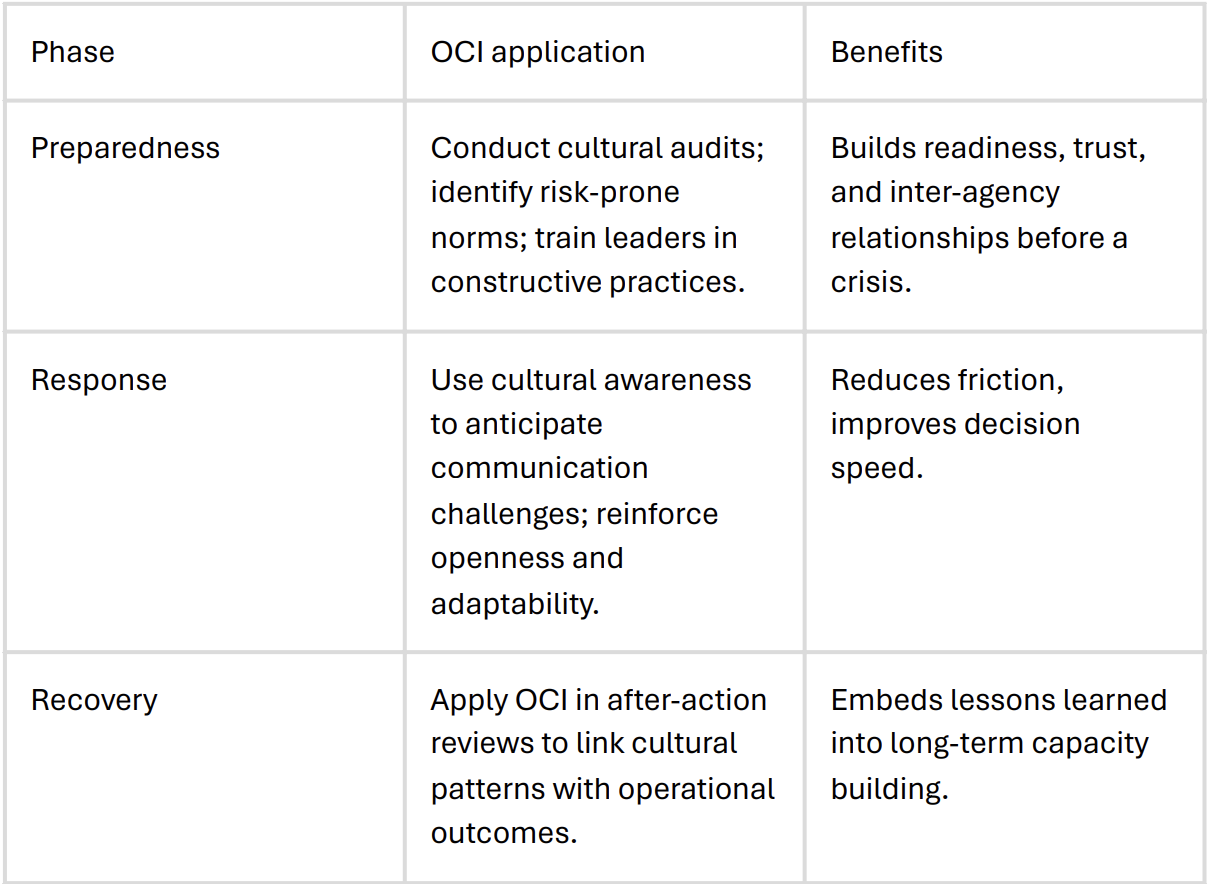
Practical Implementation Strategies
For leaders in the disaster response and relief, developing and embedding a Constructive organisational culture involves four key steps:
- Assessment: Conduct OCI surveys to establish a baseline cultural profile.
- Feedback and dialogue: Share results openly with staff, promoting honest discussion about strengths and areas for improvement.
- Action planning: Align cultural change initiatives with operational goals, focusing on leadership, communication, and collaborative practices.
- Monitoring: Repeat OCI assessments periodically to track progress and sustain momentum.
These strategies ensure that cultural change is not a one-time event, but an ongoing process embedded in organisational development.
Disaster response and relief require the ability to quickly and creatively adapt strategies in response to new information and changing circumstances. Cultures dominated by Constructive styles, as identified by the OCI, support:
Challenges and Considerations
While the OCI is a powerful tool, its effectiveness depends on genuine commitment from leadership and staff. Cultural change requires patience, persistence, and willingness to confront uncomfortable truths. Disaster relief organisations must balance the need for rapid action with the deep work of culture building. Nevertheless, the rewards—a safer, more adaptive, and more effective response capability—more than justify the investment.
Conclusion
In the relentless, unpredictable world of disaster response and relief, organisational culture is the silent architect of disaster response. It is an invisible force and actionable asset. It shapes every decision, action, and outcome in incident management. A culture grounded in the values of adaptability, transparency, and compassion can transform chaos into coordinated action. By recognising and cultivating a constructive organisational culture, agencies not only strengthen their capacity but also contribute to a more effective, humane, and resilient global disaster response system. The Human Synergistics® OCI offers a pathway to understanding and enhancing this asset. By leveraging the OCI, organisations can cultivate cultures that empower individuals, foster collaboration, adapt to adversity, and sustain wellbeing. In doing so, they dramatically improve their ability to meet the ultimate test: saving lives and restoring hope when disaster strikes.
References
- Comfort, L. K., et al. (2010). Designing Resilience: Preparing for Extreme Events. University of Pittsburgh Press.
- Cooke, R. A., & Lafferty, J. C. (1987). Organisational Culture Inventory. Human Synergistics International.
- Tierney, K. (2014). The Social Roots of Risk: Producing Disasters, Promoting Resilience. Stanford University Press.
- UN OCHA. (2010). Haiti Earthquake Response Evaluation. United Nations.
Read more:

Leadership and the Importance of Self-Awareness in Disaster Relief Incident Management